Basement and Foundation Insulation in Charlotte, NC
Insulating your Charlotte basement or foundation walls with spray foam eliminates cold floors, controls moisture, and creates usable conditioned space. The most effective single insulation improvement for homes with uninsulated basements.
Basement Spray Foam Insulation in Charlotte
Charlotte's building stock includes many homes with full basements or partially below-grade spaces, particularly in older neighborhoods and in the Piedmont communities to the north and west of the city. These basements are often uninsulated or have older fiberglass batt insulation in the framed interior walls -- leaving the concrete or masonry foundation walls themselves as a large thermal bridge to the exterior soil.
Spray polyurethane foam applied directly to the interior face of concrete or masonry basement walls is the most effective basement insulation approach for Charlotte homes. Closed cell foam adheres directly to the concrete, provides R-6.5 per inch, and serves as both insulation and vapor retarder -- critical in Charlotte's mixed-humid climate where basement walls can experience moisture drive from both directions depending on season.
The rim joist area -- where the floor framing sits on top of the foundation wall -- is one of the most significant air leakage points in a home with a basement. We insulate rim joists as part of every basement insulation project, typically with 3 to 4 inches of closed cell foam (R-19 to R-26) applied directly to the rim joist and sill plate area.
- Eliminates cold basement floors and walls -- creates usable conditioned space
- Closed cell foam adheres directly to concrete and masonry -- no gaps or voids
- Provides R-value AND vapor retarder function in one product
- Rim joist insulation included -- addresses primary air leakage point
- Prevents condensation on cool basement walls in summer
- Extends conditioned space to the basement level, reducing heating/cooling costs
Get a Free Estimate
Our Process
We follow SPFA (Spray Polyurethane Foam Alliance) installation protocols on every project.
- 1
Basement Assessment
We inspect the basement for existing insulation, moisture conditions, water intrusion history, and any conditions that need to be addressed before insulation (active leaks, drainage issues, mold).
- 2
Moisture Pre-Screening
Basement walls must be free of active water intrusion before spray foam application. We verify wall moisture conditions and advise on any pre-insulation remediation needed.
- 3
Wall and Rim Joist Preparation
Work area is protected. Existing fiberglass or loose insulation is removed from the rim joist area. Wall surfaces are clean and dry.
- 4
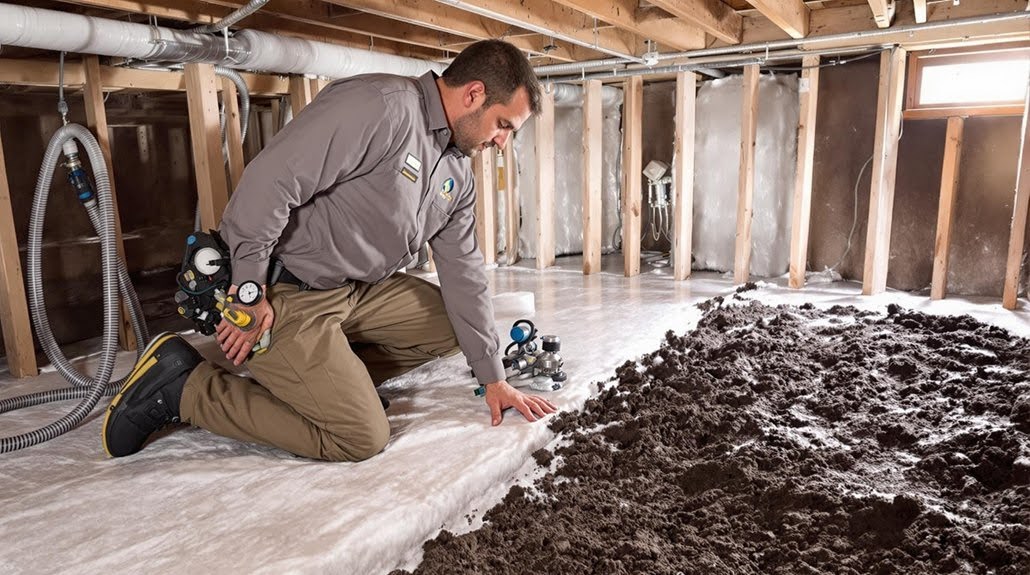
Foam Application
Closed cell foam is applied to foundation walls and rim joists. Thickness varies per specification (typically 2 to 4 inches on walls, 3 to 4 inches on rim joists). Applied in controlled lifts per manufacturer specifications.
- 5
Ignition Barrier (if required)
In finished or habitable basement spaces, NC Building Code requires an ignition barrier over exposed foam. We apply code-compliant paint coating or thermal barrier as required.
Frequently Asked Questions
Is spray foam good for basement walls in Charlotte?
Yes. Closed cell spray foam is the preferred product for interior foundation wall insulation in Charlotte because it provides both insulation and vapor retarder function, adheres directly to concrete without a separate vapor barrier, and is not damaged by the occasional moisture conditions typical in Carolina basements.
Should I insulate the basement walls or the floor above?
For a basement you want to condition (heat/cool and use), insulate the walls. For an unconditioned basement you only want to keep the floors above warm, insulate the floor above. In most Charlotte homes, conditioning the basement by insulating the walls is the better long-term option because it creates dry, usable square footage.
How thick should basement foam be in Charlotte?
In Climate Zone 3 (Charlotte), NC Energy Code requires minimum R-5 for basement walls continuous insulation or R-13 in a wood-framed interior wall. Two inches of closed cell spray foam on the foundation wall provides R-13 and satisfies code. We typically recommend 3 inches (R-19) for better long-term comfort and energy performance.
What about water in my basement?
Active water intrusion must be addressed before spray foam is applied. Spray foam does not stop active water leaks and applying it over a wet wall traps moisture. We assess moisture conditions as part of our initial inspection and will not apply foam over active water issues. We can refer waterproofing contractors if that remediation is needed first.
Ready to Get Started?
Get your free spray foam estimate from Charlotte's most trusted insulation specialist.