Crawl Space Vapor Barrier Installation in Charlotte, NC
A heavy, sealed vapor barrier over your crawl space floor stops the ground moisture that feeds musty smells, damp insulation and wood rot. It is the first step in any dry crawl space and the right fix on its own for many Charlotte-area homes.
What a Crawl Space Vapor Barrier Does
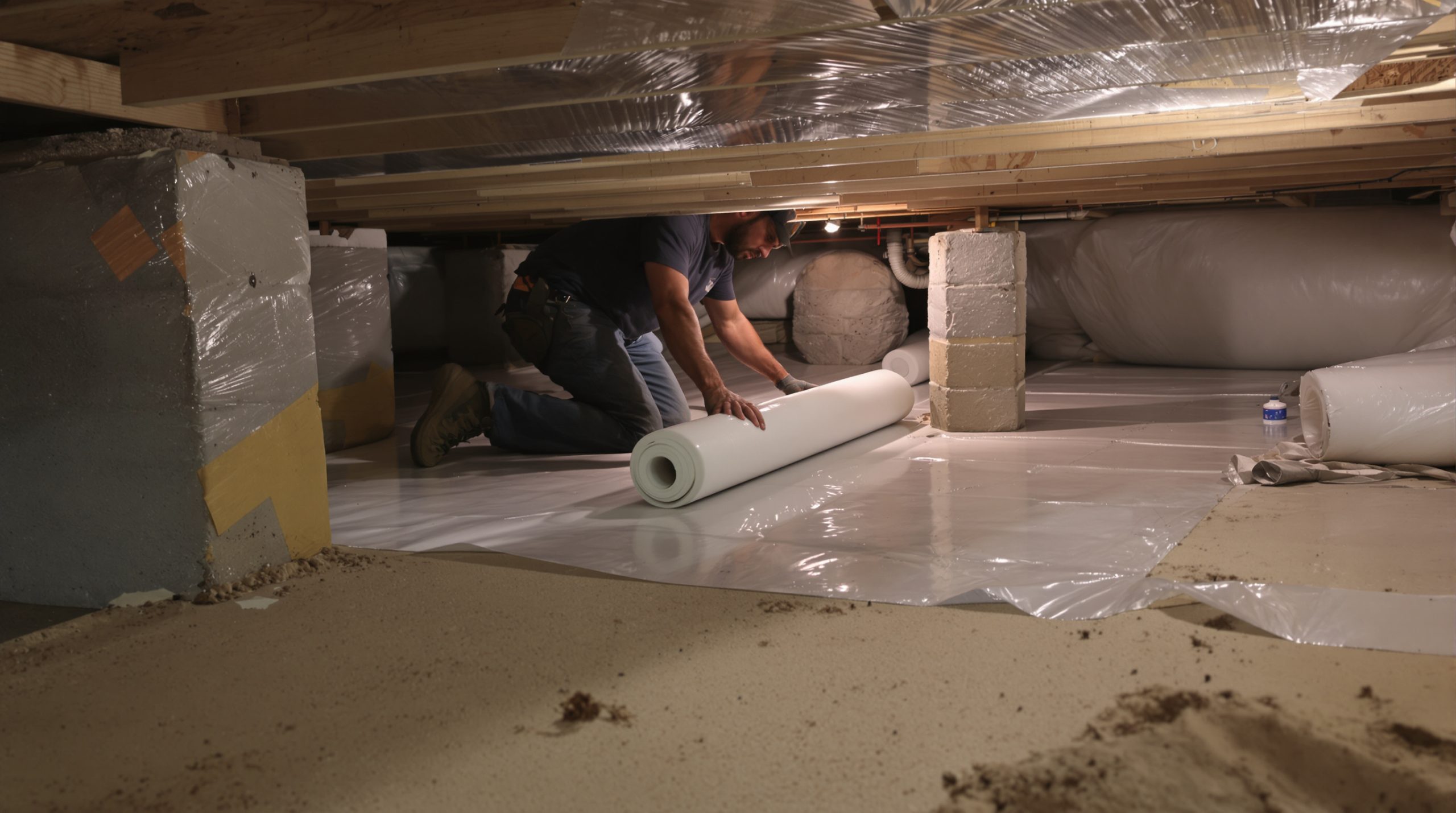
Bare dirt under a house gives off water vapor all day, every day. In the red clay soils around Charlotte that moisture has nowhere to go, so it climbs into the crawl space air, soaks the floor joists and eventually works its way into the rooms above. A vapor barrier (also called a moisture barrier or ground liner) is a sheet of thick polyethylene laid over the soil, lapped at the seams and sealed so that vapor stays in the ground.
Many older homes in the metro have a thin 6-mil sheet that was laid loose decades ago. It is usually torn, bunched up against the piers or missing entirely in the corners. We remove what is failing and install a heavier reinforced liner, run it up the piers and foundation walls, tape every seam and fasten the edges so it stays put.
A vapor barrier on its own controls ground moisture. When you also want the vents sealed, the walls insulated and the humidity managed, the vapor barrier becomes the floor of a full crawl space encapsulation. We will tell you which one your crawl space actually needs.
- Blocks ground moisture at the source instead of drying it after the fact
- Helps stop musty odors from reaching the living space
- Keeps floor joists, subfloor and insulation drier
- Gives a clean, walkable surface for plumbers, electricians and HVAC techs
- Makes the crawl space less inviting to pests that like damp soil
- Reinforced liners that hold up to crawling and foot traffic
Contact Us For a Free Quote
Signs Your Crawl Space Needs a New Vapor Barrier
- Bare dirt or a torn, bunched-up plastic sheet on the crawl space floor
- A musty or earthy smell inside the house, worst in summer
- Condensation or white fuzz on floor joists and ductwork
- Fiberglass batts sagging or falling out of the joists
- Cupping or soft spots in hardwood floors above
- Standing water after heavy rain (fix drainage first, then the barrier)
Our Process
Every crawl space is different, so we inspect before we quote and fix water problems before we cover the floor.
- 1
Crawl Space Inspection
We check moisture readings in the wood, the condition of any existing liner, drainage, standing water and access so the quote matches what is really down there.
- 2
Clean-Out and Prep
Old torn plastic, debris and failed insulation are removed and the soil is leveled where needed so the new liner lies flat.
- 3
Liner Installation
A heavy reinforced vapor barrier is rolled out across the floor with generous overlaps at every seam.
- 4
Seal and Fasten
Seams are taped, the liner is run up the piers and walls and fastened, and penetrations are sealed so vapor cannot slip past.
- 5
Walk-Through
We show you the finished crawl space and explain what to watch for, including when a dehumidifier or full encapsulation would help.
Financing Available
Monthly payment options are available for crawl space vapor barrier installation, including crawl space work and roofing. Ask about financing when you book your free estimate and we will walk you through the options before any work starts.
Related Services
Part of our crawl space encapsulation work across the Charlotte Metro Area.
Proudly Providing the Following Services throughout the Charlotte Metro Area
Spray Foam Insulation
Crawl Space & Water Control
Frequently Asked Questions
What is the difference between a vapor barrier and crawl space encapsulation?
A vapor barrier covers the crawl space floor to block ground moisture. Encapsulation goes further: the liner covers the floor and walls, the foundation vents are sealed, the walls are insulated and the air is kept dry, usually with a dehumidifier. A vapor barrier is often the first stage, and it can be upgraded to full encapsulation later.
How thick should a crawl space vapor barrier be?
The old minimum of 6-mil plastic tears easily and is the sheet we replace most often. For a crawl space that people will crawl through for service calls, a heavier reinforced liner holds up far better. We recommend the thickness at the estimate based on how the space is used.
Does a vapor barrier stop water in the crawl space?
No. A vapor barrier stops water vapor rising from the soil. Liquid water from poor drainage has to be handled with grading, downspout extensions, a French drain or a sump pump first, otherwise water can pool on top of the liner.
How long does a crawl space vapor barrier last?
A properly installed reinforced liner that is sealed and fastened should last for decades. Paired with encapsulation, the moisture barrier and foam system is expected to be there for around thirty years, depending on the materials used and how the crawl space is treated.
Can you install a vapor barrier in a crawl space with ductwork and plumbing?
Yes. Almost every crawl space in the Charlotte area has ducts, plumbing and wiring running through it. We cut and seal the liner around piers, pipes and supports so the barrier stays continuous.
How much does a crawl space vapor barrier cost?
Cost depends on the square footage, the crawl space height, how much old material has to come out and whether any drainage work is needed first. We give a written quote after an on-site inspection, and financing is available.
Charlotte Metro Service Area
If you don't see your area listed, call us at (704) 741-5560 and we'll let you know if we service your area.
Albemarle
Ballantyne
Belmont
Charlotte
Concord
Cornelius
Cramerton
Davidson
Fort Mill
Gastonia
Harrisburg
Huntersville
Indian Trail
Kannapolis
Lake Wylie
Locust
Lowell
Marshville
Marvin
Matthews
Midland
Mint Hill
Monroe
Mooresville
Mount Holly
Oakboro
Pineville
Rock Hill
Stallings
Stanley
Steele Creek
Troutman
University City
Wadesboro
Waxhaw
Weddington
Wingate
Ready for a Drier Crawl Space?
Book a free crawl space inspection anywhere in the Charlotte metro.